


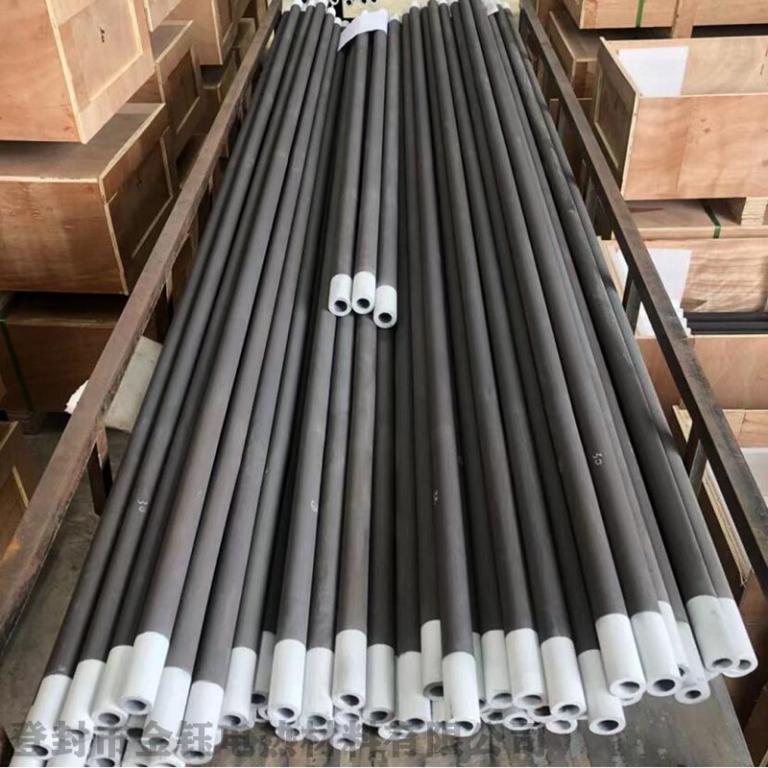
Isodiametric silicon carbide heating tubes for glass furnaces
Contact Info
- Add:, Zip: 452470
- Contact: 杜先生
- Tel:15981823366
- Email:53663078@qq.com
Other Products


Application of Silicon Carbide Rods in the Glass Industry:
1. Cooling Section and Homogenization Section
As the glass melt flows through the cooling and homogenization sections, it should be uniformly cooled to a temperature suitable for forming. If no measures are taken, the sides of the channel dissipate more heat, while the central area dissipates less, resulting in a significant temperature gradient between the center and the sides of the glass. This leads to uneven temperature across the same cross-section of the glass melt, causing inconsistencies in viscosity, which directly affects forming quality. To ensure uniform temperature of the melt, cooling holes are reserved in the cooling section, and the degree of opening of these holes is adjusted to regulate heat dissipation in the central area of the channel's cooling section, thereby achieving temperature uniformity. Additionally, specialized silicon carbide rods are used for auxiliary heating. These rods are typically evenly arranged above the glass melt in the feeder channel, maintaining a certain distance from the melt and radiating heat downward. To ensure heating on the sides of the channel without heating the central area, five-section silicon carbide rods (i.e., dual-heating-element silicon carbide rods) specifically designed for the glass channel industry are generally used. These rods consist of two identical heating elements and three cold ends welded together using a special process, with a cold end connected between the two heating elements. The total length of the three corresponds to the width of the channel (dual-thread silicon carbide rods are used in imported channels). Since the central part of the silicon carbide rod does not generate heat or generates less heat, while the areas near the side walls generate heat, combined with rational design, this ensures uniform temperature reduction of the glass melt during flow. Some manufacturers also opt for equal-diameter silicon carbide rods (i.e., three-section silicon carbide rods) during channel design, which consist of one heating element and two cold ends welded together.
Using three-section silicon carbide rods in the channel heats both the glass melt and the side walls, ensuring the temperature in each section of the feeder channel and supplementing heat loss from the side walls. However, the homogenization effect is far inferior to that of five-section rods. Whether three-section or five-section rods are chosen, the homogenization effect depends on the structure of the feeder channel and the heating provided by the silicon carbide rods, while the final temperature achieved in each section of the feeder channel is controlled by the control system.
2. Gob Section
After the glass melt flows through the homogenization section, its temperature is uniformly reduced to a suitable value. However, if the temperature at the gob is not controlled, it remains difficult to ensure a constant and uniform temperature for the gob. Temperatures that are too high or too low can affect the shape of the gob, ultimately impacting the forming quality of glass containers. Therefore, the scientific approach is to control the gob separately. Gob heating generally takes the following two forms:
(A) Using two gun-type silicon carbide rods and one three-section silicon carbide rod arranged around the gob for heating.
(B) Using two trough-type silicon carbide rods and one three-section silicon carbide rod evenly distributed around the gob for heating.
| Industry Category | Chemicals/Inorganic Salts/Silicates |
|---|---|
| Product Category | |
| Brand: | 金钰 |
| Spec: | 按需定制 |
| Stock: | 10000 |
| Manufacturer: | 登封市金钰电热材料有限公司 |
| Origin: | 114101 |


